
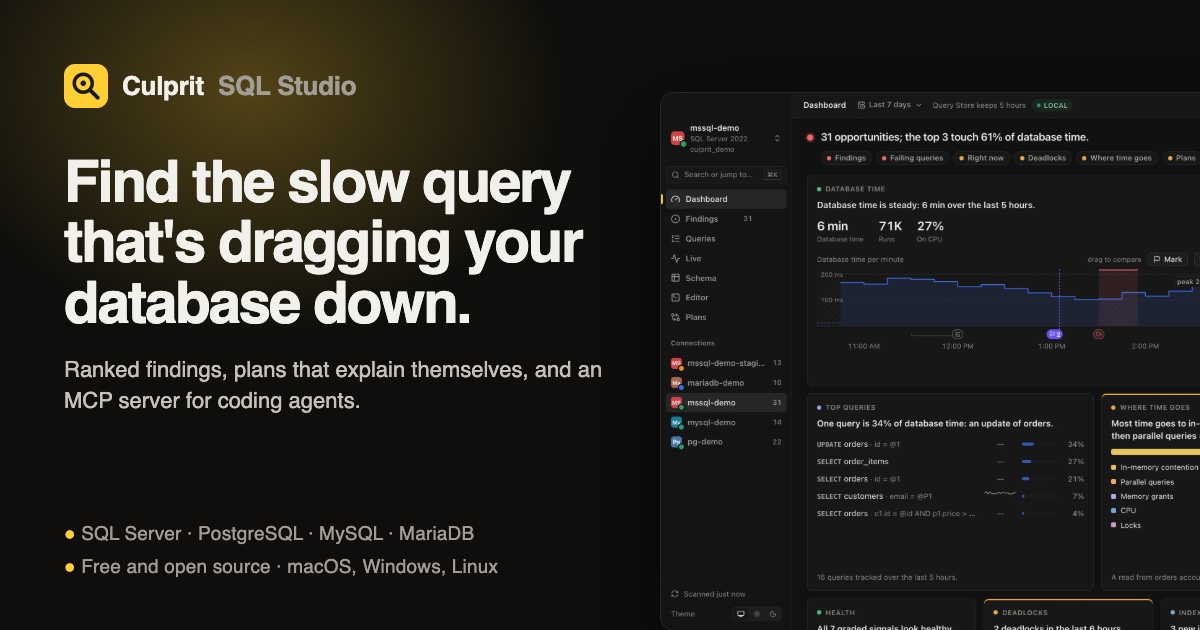
Culprit SQL Studio is an open-source database performance tool for SQL Server, PostgreSQL, MySQL and MariaDB. It reads the statistics the database already keeps and explains each slow query, index gap or lock problem in one sentence.
What is Culprit SQL Studio?
Culprit connects to a database with a login that can read statistics, such as Query Store, the plan cache, pg_stat_statements or performance_schema. It runs 51 checks and ranks the findings by their share of database time. Covered problems include plan regressions, parameter sniffing, missing and unused indexes, N+1 query loops, implicit conversions, spills to disk, stale statistics, lock waits and deadlocks. Each finding comes with the evidence, a fix described as safe for production and a way to verify it.
The desktop app draws execution plans, explains them in plain words and compares any two plans, with a headline reason why one is slower. A regression view compares two time periods and lists what got slower, what is new and what improved, next to deploys and statistics updates. A live view shows blocking chains as a tree. The CLI prints JSON for every command, and culprit mcp serves 25 tools to MCP clients. Scans are read-only, fixes are shown and never applied, and anything beyond a provable read asks first on production.
Who is Culprit SQL Studio for?
Developers and database administrators who need to find why a SQL Server, PostgreSQL, MySQL or MariaDB database is slow, without installing anything on the server. It also suits teams that want coding agents to inspect database performance with read-only access.
Highlights
- 51 checks ranked by share of database time
- Supports SQL Server 2022, Azure SQL Database, PostgreSQL 15 to 18, MySQL 5.7 to 8.4 and MariaDB 10.5 to 11.8
- Compares any two execution plans and states why one is slower
- MCP server with 25 tools for Claude Code, Codex and Cursor
- Read-only scans of statistics and catalog views
- MIT licensed, 14 MB native app for macOS, Windows and Linux
How much does Culprit SQL Studio cost?
Open source. Free and released under the MIT license. The site lists no paid plans.