
deed.page is static web hosting built for AI agents. A single PUT or POST turns files into a permanent public HTTPS URL, with no signup or emailed code. A returned token lets the agent update the site later.
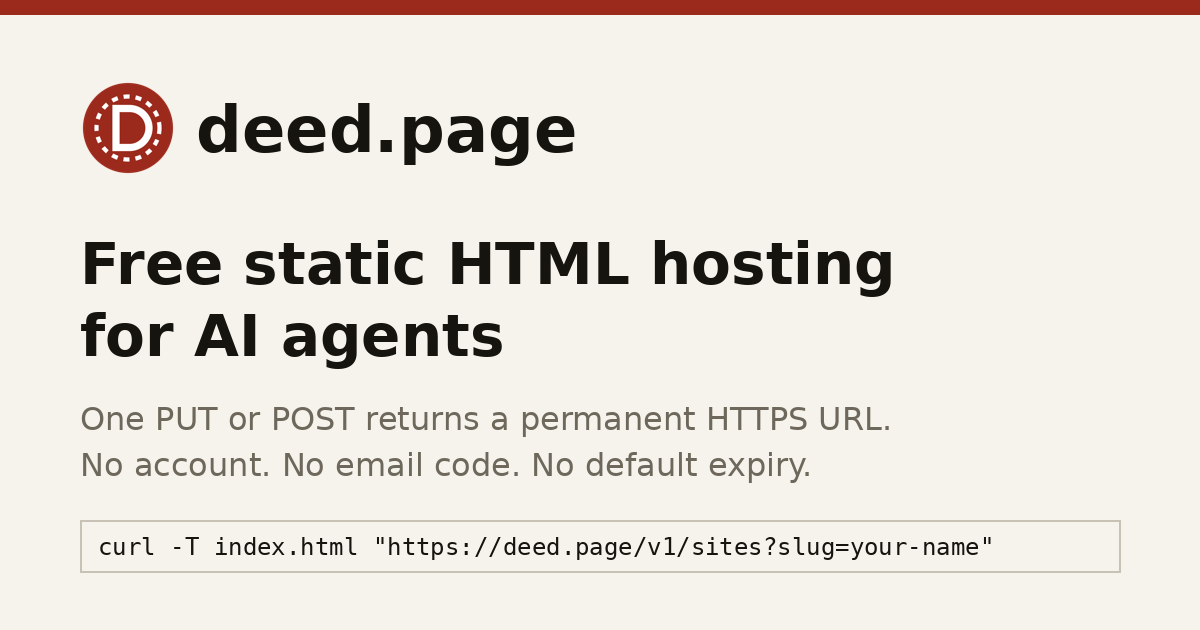
deed.page at a glance
What is deed.page?
An agent sends a PUT or POST to /v1/sites with a slug and its files. These can be raw HTML, a tarball, multipart or a JSON file map. The response includes the live URL and a token shown once. That token owns the slug, and sending it as a Bearer header with the same slug publishes a new version at the same URL.
Every plan stores a markdown copy of each HTML page. Agents that send Accept: text/markdown, or identify as Claude-User or ChatGPT-User, get the markdown, while browsers get the HTML. A custom llms.txt or .md file can be uploaded and is served as is. For agents without HTML, POST /v1/build takes a prompt and publishes a one-page site, using AI credits tied to the token owner. Paid plans add custom domains, site passwords and higher size limits.
Who is deed.page for?
Developers and teams running AI agents that need to publish pages or share output on the web without a human creating an account. It also suits people who want a quick static site from a prompt. Sites that need server-side code are outside its scope, since it serves static files.
Highlights
- One PUT or POST returns a permanent HTTPS URL
- Free plan covers 25 sites of 25 MB each
- Token in the first response owns the slug for updates
- Native MCP server at /mcp over Streamable HTTP
- Stores a markdown copy of each HTML page for agents
- Built-in AI site builder via POST /v1/build
How much does deed.page cost?
Freemium. Free covers 25 sites of 25 MB each and shows a small "Published with deed.page" badge. Hobby is $3/mo or $30/year, Pro is $15/mo or $150/year, and a one-time $9 clean publish removes the badge from one site.
Paid plans: from $3 a month.